How to Choose and Use a Budget Planner in Australia
By Fay & Form Studio · 7 October 2026
Taking control of your money starts with a clear plan. For households and individuals, finding the right budget planner can improve financial habits. This guide from Fay & Form Studio helps you understand your options and put a practical system in place. A budget planner only works if it matches how often you get paid. By exploring different tools, you can find the best option to suit your needs. We cover free government resources and tailored digital planners. We will also walk you through setting up your first month of budgeting.
Choosing the Right Budgeting Tool for Australia
Australians have many choices for managing their money. The key is finding a tool that fits your lifestyle. It should help you track income and expenses without adding stress. Whether you prefer digital convenience or paper, there’s a planner out there for you.
We compare the main types: free online calculators, printable templates, spreadsheets, and dedicated apps. Each has strengths. Understanding these helps you decide which approach works best for your household budgeting needs.
Government Resources: The Moneysmart Budget Planner
A great starting point for anyone in Australia looking to budget is ASIC's Moneysmart website (moneysmart.gov.au). This government resource offers a free online budget planner. It is a straightforward tool. It helps you see where your money goes. You input your income and expenses. It then provides a summary, highlighting areas where you might save.
The Moneysmart planner is an excellent educational tool. It provides general information, not financial advice. It is a solid, no-cost option to get a basic overview of your finances. Use it before deciding if you need a more detailed system. It is a practical first step for many Australians to understand their financial landscape. It shows how a comprehensive budget system can help them.
Using a Budget Planner Template for Clarity
For those who prefer a hands-on approach, a physical or printable budget planner template offers a clear, tangible way to manage money. Writing down your budget helps you connect with your finances more deeply. It is also great for visual learners or anyone who enjoys planning on paper. This method is a popular choice for many Australians.
Printable templates often feature structured pages for income, expenses, savings goals, and debt tracking. They are useful for households that like to sit down and discuss finances away from screens. You can print new pages as needed. This makes it a flexible and reusable option.
For example, the Printable Budget Planner from Fay & Form Studio prints beautifully at home. It includes 71 undated pages. A 16-page filled example at the front shows you how each section works. Its white pages, light tints, and thin outlines mean it prints well in colour or black and white. It uses far less ink than a full-colour planner. This template lets you customise your budgeting binder by reprinting templates whenever you need more pages.
Spreadsheet Budgeting Tools: Simple and Powerful
Spreadsheets offer flexibility and automation for budgeting. A spreadsheet-based template lets you input your data. Formulas do the calculations for you. This means totals, charts, and 'left to spend' figures update automatically. You get an immediate snapshot of your financial situation.
They are ideal for users comfortable with basic computer skills. They offer more control than an app, but less manual work than a paper planner. Spreadsheets can be customised to fit specific needs. Use them for a complex household budget or a simple personal one.
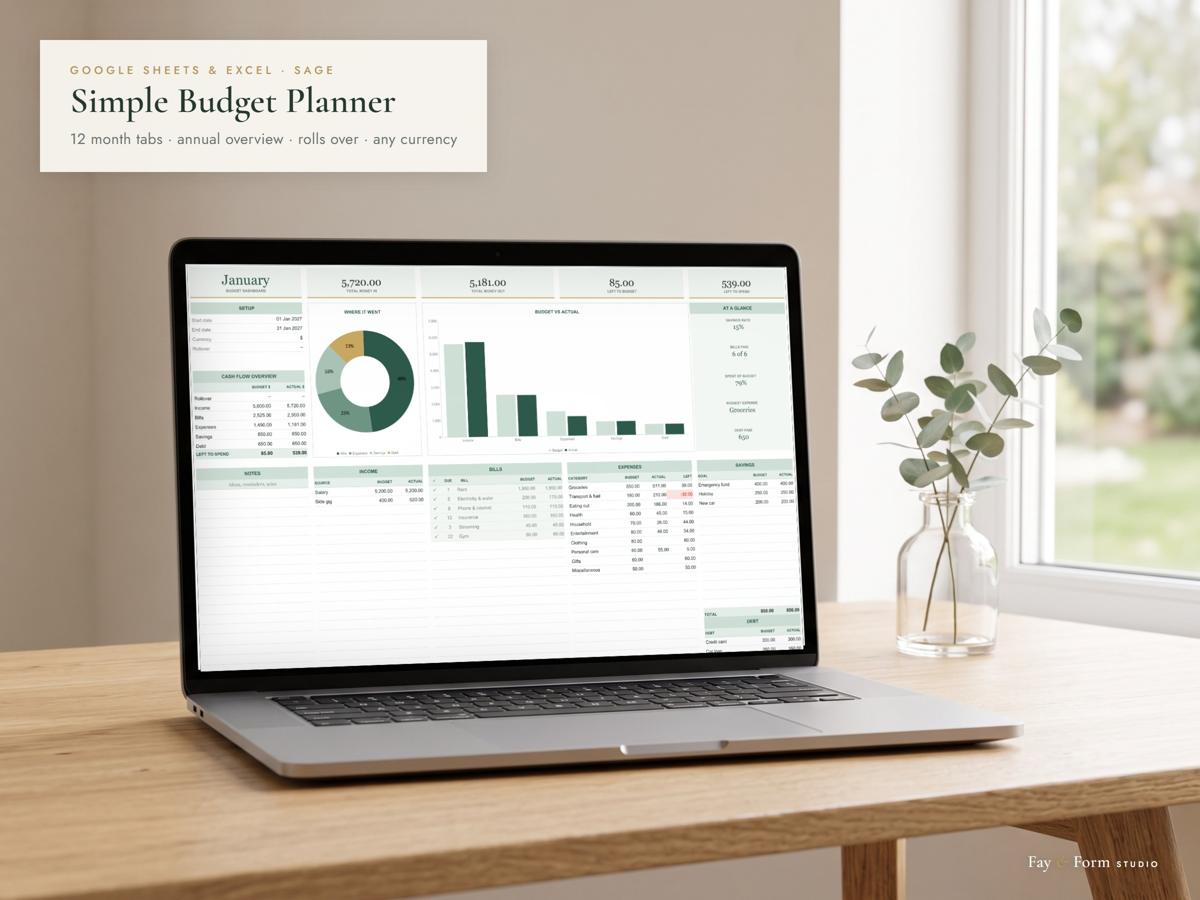
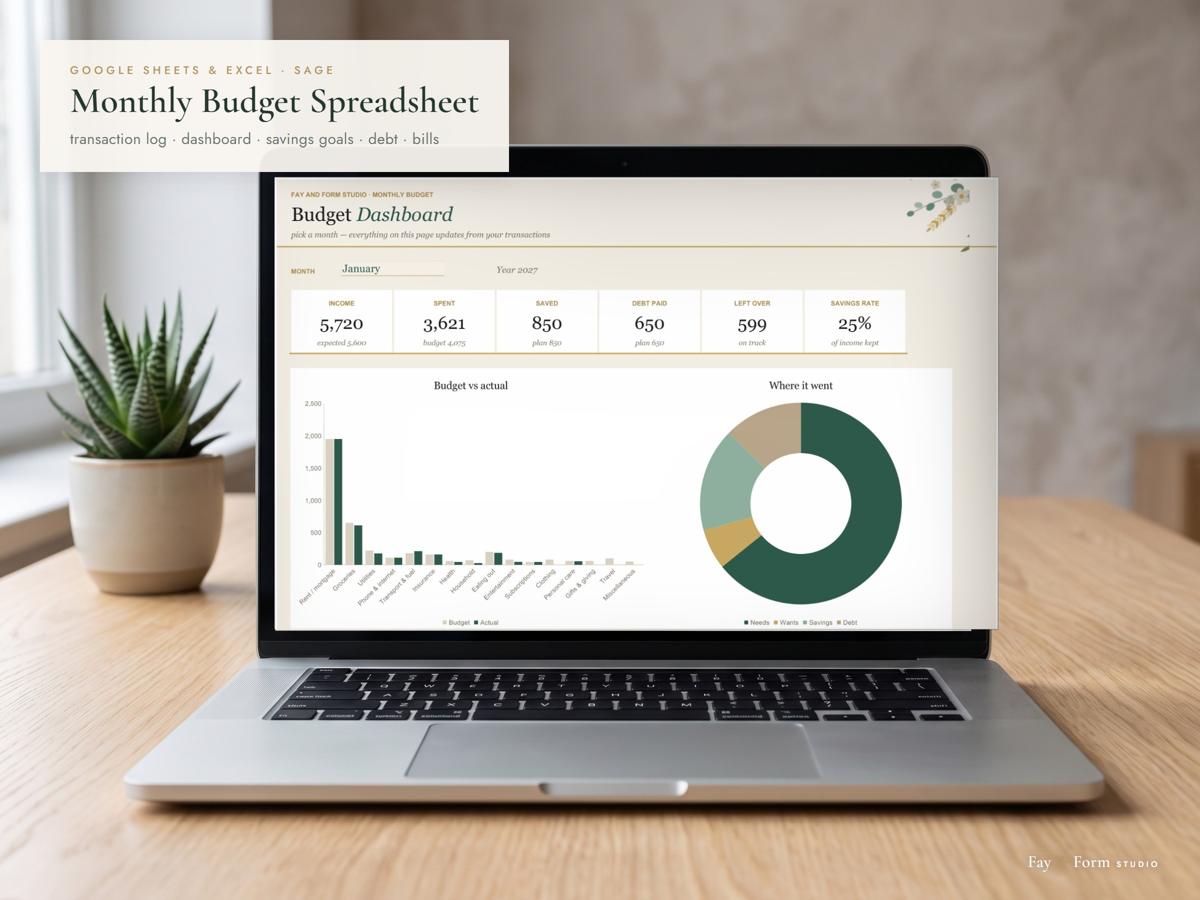
The Simple Budget Planner (Sage) from Fay & Form Studio is a great example. It is available for Google Sheets, Excel, and Apple Numbers. Priced at A$9.90, it puts every month of your money on one calm screen. You type what you expect to spend and what actually happens. The totals update. It is designed for any currency. It includes 12 monthly tabs, each on one landscape screen. Plus, a four-figure strip across the top shows money in, money out, and what is left. This kind of template removes the need for a separate transaction log, making the process simpler.
If you are looking for more options, Fay & Form also offers a range of budget spreadsheets. These are designed to simplify your financial tracking.
Exploring a Budget Planner App for Modern Management
In today's fast-paced world, a budget planner app can be a convenient way to manage your money on the go. Apps offer instant access to your budget. They often include visual dashboards, transaction logging, and reminders for upcoming bills. They are perfect for those comfortable with technology who want to track spending in real-time. Many Australians find a digital planner highly effective.
Many apps connect directly to bank accounts, automatically categorising transactions. This can be a powerful feature. Always research the security and privacy policies of any app that requires access to your financial data. For a simpler approach, some apps function more like digital planners. They require manual input but offer hyperlinked navigation and a clean interface.
Fay & Form Studio runs a household planner app. It provides a digital space for various planning needs. Ready-made app planners currently include specific themes like the Ramadan kids planner, a home garden planner, and a dog care planner. Each has a free demo. The core app platform offers a flexible way to manage information digitally. The free plan allows one person to open one planner in the app without needing a card. Family sharing starts with Tier 1 at A$29 a year. You can learn more about the Fay & Form planner apps and their pricing options.
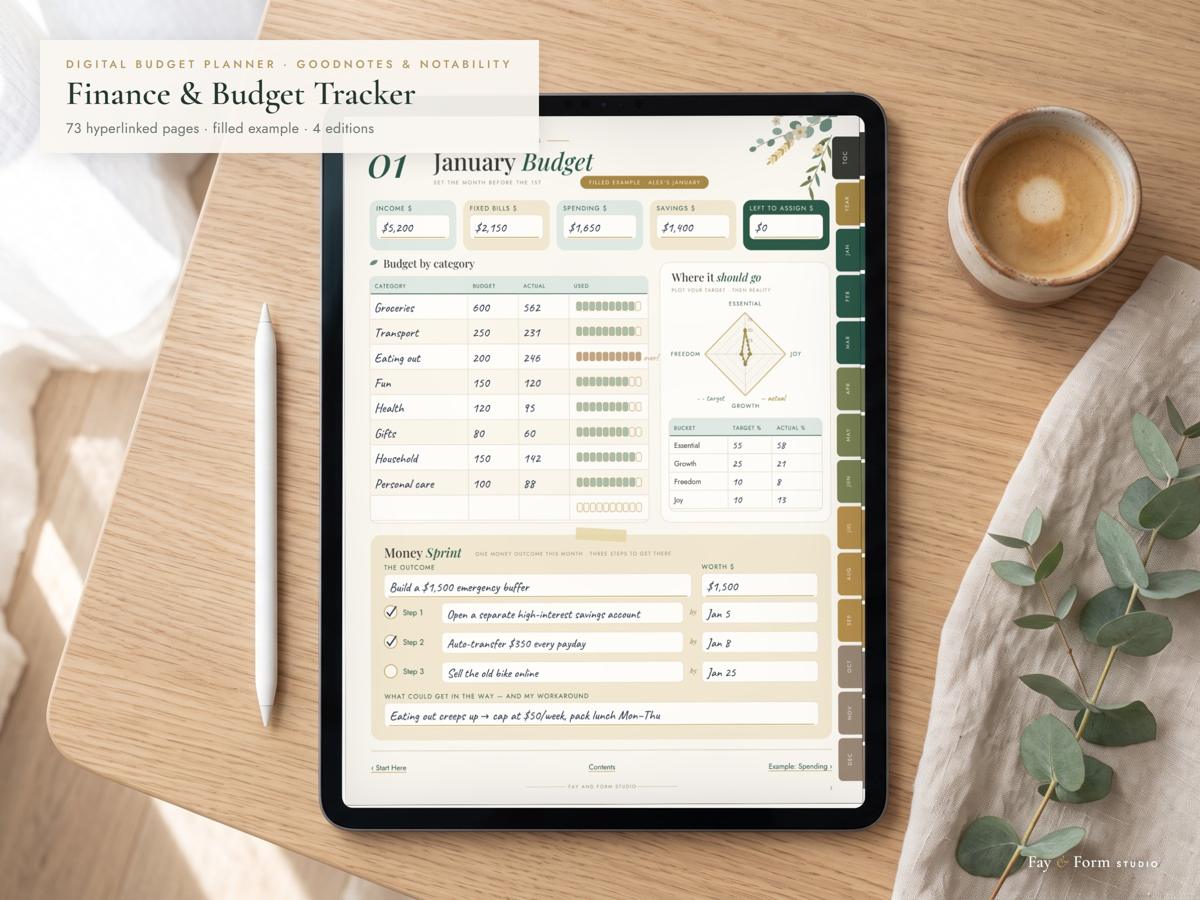
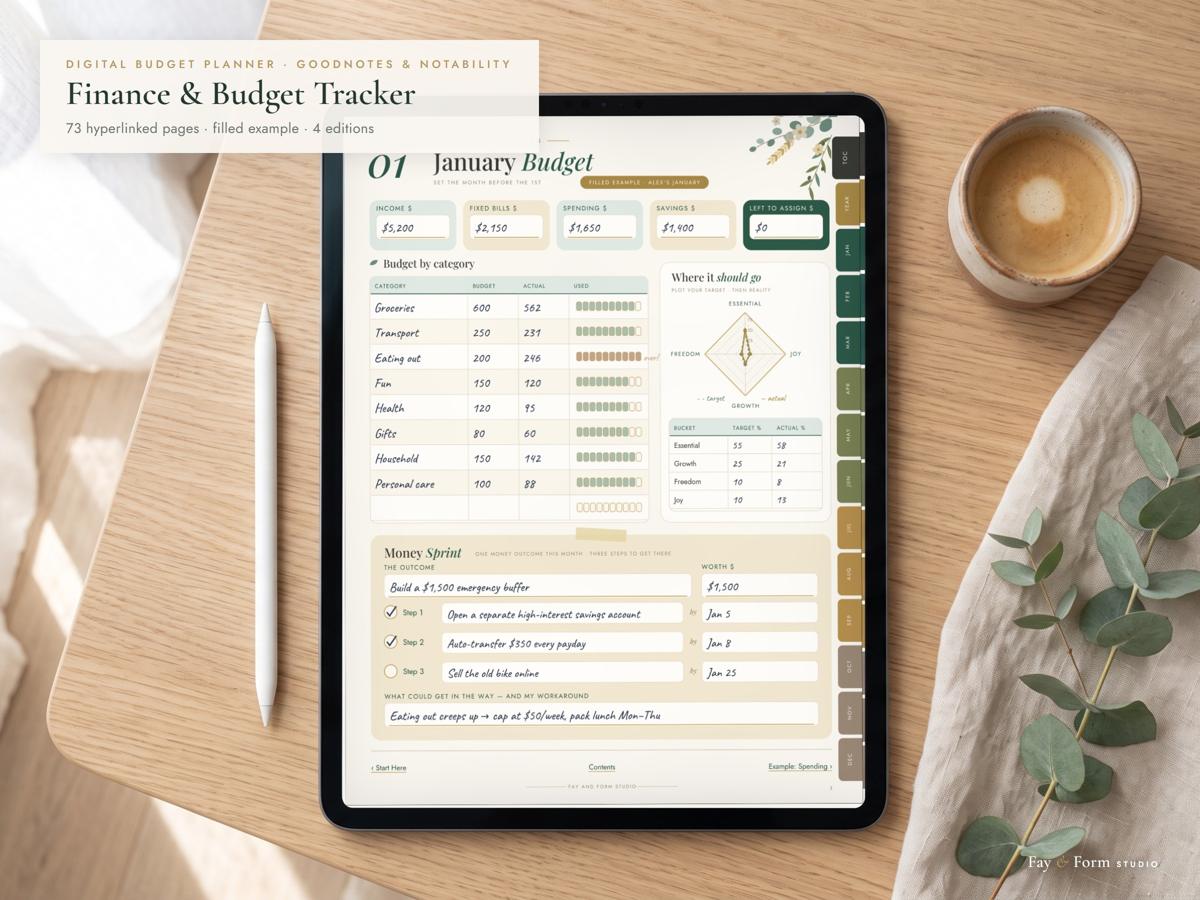
A digital money planner, designed to work in a PDF annotation app, offers the best of both worlds. It combines the structure of a template with the interactivity of an app. The Budget Planner Digital from Fay & Form Studio (A$14.90) is one such option. This calm, beautifully designed digital planner provides a filled example (Alex's January). You can see exactly how to use it. Each month features three linked pages: Budget, Spending, and Review. You plan where your money should go, log what you spend, and then take two minutes to see what worked. It is a comprehensive digital planner solution in PDF format, compatible with standard PDF annotation apps.
Inside the Budget Planner Digital, you will find 73 pages and over 1,300 links. It includes money setup, a year at a glance, a paycheck budget, a bill calendar, and 12 months of detailed budgeting. There are also quarter reviews, a 'Year in Money' summary, debt payoff trackers, sinking funds, a 100-step savings challenge, net worth calculations, a no-spend tracker, subscriptions audit, and a big-purchase planner. It comes with five files: US Letter fillable, Handwriting, A4 (for Australia, the UK, and Europe), Phone (a separate layout for phone screens), and a 'Start Here' guide. This makes it a versatile digital planner alternative for various devices.
Creating Your First Household Budget Planner: A Step-by-Step Guide
Getting started with your first household budget planner can feel overwhelming. Breaking it down into simple steps makes it manageable. Here is how Australians can set up their budget. Focus on common pay cycles and financial goals.
Step 1: Gather Your Financial Information
- Income: List all sources of income for your household. Many Australians are paid fortnightly, so consider your pay cycle. If you are paid fortnightly, you might find our fortnightly budget planner guide helpful.
- Fixed Expenses: These bills are the same every month or period. Examples include rent/mortgage, loan repayments, insurance, and subscriptions.
- Variable Expenses: These change. Examples include groceries, transport, utilities (which can fluctuate), entertainment, and dining out.
- Debts: List any outstanding debts with their minimum payments and interest rates.
- Savings Goals: What are you saving for? A house deposit, holiday, emergency fund, or new car?
Step 2: Choose Your Budgeting Period
Many Australians are paid fortnightly. So, a fortnightly budget can often be the most natural fit. However, you can choose to budget weekly or monthly. Consistency is important. Align your budget period with your income frequency. If you get paid fortnightly, budgeting fortnightly simplifies matching income to expenses.
Step 3: Allocate Your Income
- Bills First: Set aside money for all your fixed expenses and bills as soon as you get paid. If a bill is monthly and you are paid fortnightly, divide it in half. Set aside that amount from each paycheck.
- Savings: Treat savings as a non-negotiable expense. Even a small amount regularly adds up. 'Pay yourself first' is a powerful principle.
- Debt Repayment: Beyond minimum payments, allocate extra funds to high-interest debts if possible.
- Variable Spending: What is left is for groceries, fuel, and discretionary spending. Be realistic here. It is better to overestimate slightly than to run short.
Step 4: Track Your Spending
This is crucial for understanding where your money actually goes. For the first month, track every dollar spent. Use your chosen template, spreadsheet, or app to log each transaction. Do not judge yourself; just observe.
Step 5: Review and Adjust
At the end of your first budgeting period (e.g., after two weeks if you are fortnightly), sit down with your planner. Compare what you planned to spend with what you actually spent. Ask yourself:
- Did I stick to my budget categories?
- Where did I overspend or underspend?
- Were my initial allocations realistic?
- What adjustments do I need to make for the next period?
Budgeting is an ongoing process of learning and refinement. Do not expect perfection in your first month. Every adjustment makes your household budget planner more effective.
Making Your Budget Stick: Tips for Success
A budget is only as good as your commitment to it. Here are some practical tips to help your budgeting tool become a lasting system for financial health:
- Be Realistic: Do not cut everything out. Allow for some discretionary spending to avoid burnout.
- Automate Savings: Set up automatic transfers to your savings account on payday.
- Involve the Household: If it is a household budget, ensure everyone is on board and understands the goals.
- Regular Reviews: Schedule a regular time to review your budget, whether weekly, fortnightly, or monthly.
- Emergency Fund: Prioritise building an emergency fund. This safety net prevents small setbacks from derailing your budget.
- Celebrate Wins: Acknowledge progress, no matter how small. This keeps motivation high.
- Seek Professional Help if Needed: If you are struggling with significant debt or complex financial situations, consider consulting a qualified financial advisor. This article provides general information, not financial advice.
Frequently Asked Questions
What is the best budgeting tool in Australia?
The 'best' budgeting tool depends entirely on your personal preferences and financial situation. For a free starting point, ASIC's Moneysmart online tool is excellent. If you prefer a detailed digital experience, a hyperlinked PDF planner like the Fay & Form Budget Planner Digital offers comprehensive features. For those who like spreadsheets, the Simple Budget Planner (Sage) provides powerful automation. The Printable Budget Planner suits a paper-based approach. The ideal planner is one you will consistently use.
Is the Moneysmart budget planner free?
Yes, the Moneysmart budget planner provided by ASIC (moneysmart.gov.au) is completely free to use. It is an online tool that helps Australians get a basic overview of their income and expenses. This makes it a great no-cost option for starting your budgeting process.
Should I budget weekly, fortnightly or monthly?
The most effective budgeting period often aligns with how frequently you receive your income. Since many Australians are paid fortnightly, a fortnightly budget planner can simplify matching your income to your expenses. If you are paid weekly, budget weekly. If monthly, budget monthly. Consistency with your pay cycle helps you manage cash flow more effectively.
Paper, spreadsheet or app: which budgeting tool sticks?
The budgeting tool that sticks is the one you find easiest and most enjoyable to use regularly. Paper planners offer a tangible, reflective experience. Spreadsheets provide automation and customisation for those comfortable with numbers. Apps offer convenience and real-time tracking, often with portability. Experiment with different types to find the planner that best integrates into your daily routine and helps you maintain consistency with your budget.
Conclusion
Starting a budget with a good budget planner is a powerful step towards financial clarity and control. By understanding the different tools available – from free government resources to versatile digital and printable options – you can choose a system that truly works for you. Remember, the goal is not perfection, but consistent progress. Take the first step today to gain confidence in managing your money.
Ready to get started? See the Budget Planner Digital.