Your Essential Small Business Planner for Australian Sole Traders
By Fay & Form Studio · 7 October 2026
Running a small business or working as a sole trader in Australia can feel like a constant juggle. You're the CEO, the marketing team, the accounts department, and the chief coffee maker. Keeping all these plates spinning requires a clear strategy and an organised approach. This is where a dedicated small business planner is truly valuable. It's not just about writing things down. It's about having a central hub for all your business operations. A small business planner pays for itself the first week it stops a client follow-up falling through the cracks. We're Fay & Form Studio, and we've designed planners for Australian small businesses. We understand the challenges you face, from managing client orders to navigating the BAS calendar.
Setting Your Vision: Goals and the 90-Day Plan
Every successful small business starts with a clear vision. Before you dive into the daily grind, take time to define what you're trying to achieve. Think about your 'Business Snapshot' – what products or services do you offer? Who are your ideal customers? What makes your business unique? This isn't just a simple exercise. It's the foundation for every decision you make.
Once your vision is clear, break it down into achievable goals. For sole traders, a 90-day plan is often more effective than a lengthy annual one. It keeps you focused and allows for flexibility. What are the three biggest things you want to achieve this quarter? List them. Then, break each into smaller, actionable steps you can tackle week by week. For instance, if your goal is 'Increase sales by 15%', your 90-day plan might include 'Launch new product line' or 'Run a targeted social media campaign'. Remember, a good plan also includes what you're not doing this year – setting boundaries is important for focus.
Running Your Week: A Planner for Small Business Owners
As a busy planner for small business owner, your week can quickly become a blur of tasks. To stay on top, you need a system that helps you prioritise and dedicate time to working on your business, not just in it. We call this 'CEO Hours'.
Dedicate one hour each week – perhaps Sunday evening or Monday morning – to plan your week. Look at your 90-day goals and decide your top three moves for the coming seven days. These are the non-negotiable tasks that will move your business forward. Then, categorise your other tasks into 'Make', 'Market', and 'Admin' lists. This simple structure ensures you allocate time across all key business functions. For example:
| Category | Examples for a Candle Studio |
|---|---|
| Make | Pour new candle batches, design labels, package orders. |
| Market | Schedule social media posts, write blog entry, follow up on a collaboration. |
| Admin | Pay suppliers, reconcile expenses, respond to customer emails. |
This structured approach helps any business owner ensure that vital tasks aren't pushed aside by urgent, but less important, daily demands. It brings clarity to your workload. It's a key feature for any effective planner for small business owner.
Keeping Clients and Orders Moving
Client satisfaction and efficient order fulfilment are key to repeat business and positive word-of-mouth. It’s easy for an order to get lost in the shuffle, especially if you're dealing with multiple clients or custom products. A reliable system for tracking orders is important.
Your planner should have a dedicated section for managing orders. At a minimum, track when an order is paid, when it's made (or prepared for service delivery), and when it's sent (or completed). This simple three-stage process ensures nothing falls through the cracks. Include space for customer contact details, order specifics, and any special notes. This also helps you quickly reference past orders if a customer has a query.
Beyond individual orders, keep a register of your customers. Note their preferences, previous purchases, and any relevant communication. This information is valuable for building relationships and understanding your market better. You can also use this section to track potential leads and their journey through your sales pipeline.
Tracking Income & Expenses with a Small Business Planner Template
Understanding your money is fundamental to business success. It's not enough to just know what's coming in. You need to understand your actual profit and where your money is going. A good small business planner template will provide structured pages for this.
Start with a clear picture of your income and expenses. Track your 'Money at a Glance' monthly, noting both revenue and profit. This helps you identify trends and peak seasons. On the expense side, categorise your 'Expenses & Deductions' quarterly. This is particularly useful for Australian sole traders, many of whom lodge a Business Activity Statement (BAS) each quarter. Keeping a running tally of expenses throughout the quarter makes BAS preparation much less stressful.
One of the most powerful tools in your planner is a pricing calculator. Many small business owners underprice their products or services because they don't account for all their costs. A good calculator should help you factor in:
- Materials and packaging costs
- Your time (don't forget to pay yourself!)
- Fees (e.g., payment processing, platform fees)
- Overheads (e.g., rent, utilities, software subscriptions)
This gives you a true cost, helping you set a profitable price and understand your margin per sale. Knowing what every sale really earns is a great help for growth. This is a core feature of a useful small business planner template. For a deeper dive into managing your personal and business finances, you might find our article on budget planner Australia helpful.
Content Planning and the BAS Calendar
In today's market, consistent content and smart promotions are key for visibility. Whether it's social media posts, blog articles, or email newsletters, a plan ensures you're always engaging your audience. Your planner can act as your content calendar, helping you map out themes, topics, and publishing dates across the year.
Similarly, keep track of your promotions. When are you running sales? Launching new products? Collaborating with others? Having a 'Promotions' section helps you coordinate these efforts and measure their impact.
For Australian sole traders, the Business Activity Statement (BAS) is a regular fixture. Many Australian small businesses lodge a Business Activity Statement (BAS) quarterly. While the specific dates vary slightly each year, the general rhythm remains. Mark these key dates in your planner: the end of the quarter, and the BAS lodgement and payment due dates. This simple act reduces stress and helps you avoid late fees. Having your expense and income data organised from your planner makes this process much smoother. For tips on managing your social media content, check out our content planner for social media guide.
What Makes the Best Small Business Planner?
When searching for the best small business planner, consider what truly supports your unique workflow. There's no one-size-fits-all solution, but certain features make a planner very useful for sole traders and small business owners.
A good planner should offer a comprehensive approach, covering everything from strategic goals to daily tasks and financial tracking. Look for:
- Goal Setting & Review: Pages for annual, quarterly, and weekly goal setting and regular reviews.
- Financial Tracking: Sections for income, expenses, and ideally, a pricing calculator.
- Operational Management: Tools like an order tracker, customer lists, and stock management.
- Flexibility: Undated pages allow you to start anytime and avoid wasted space.
- Ease of Use: Clear layouts and intuitive navigation.
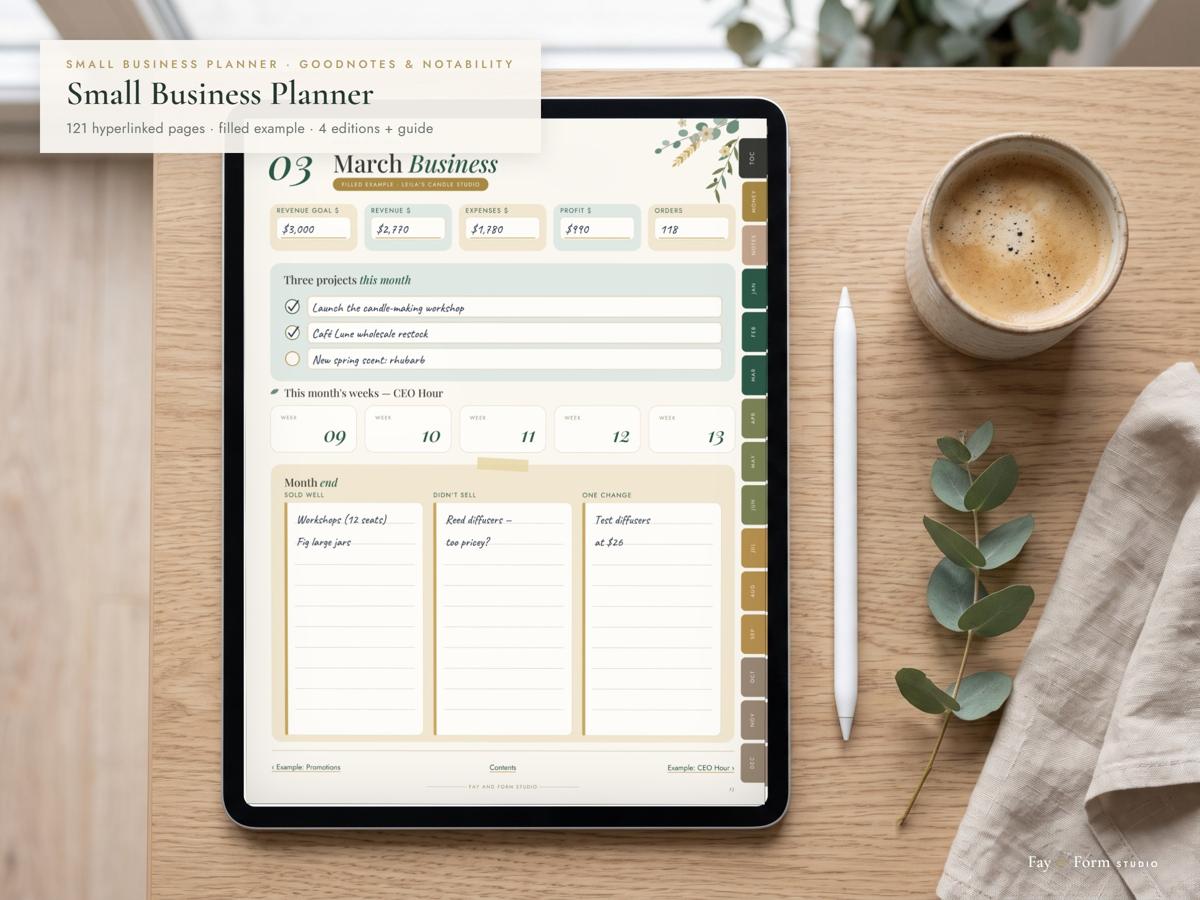
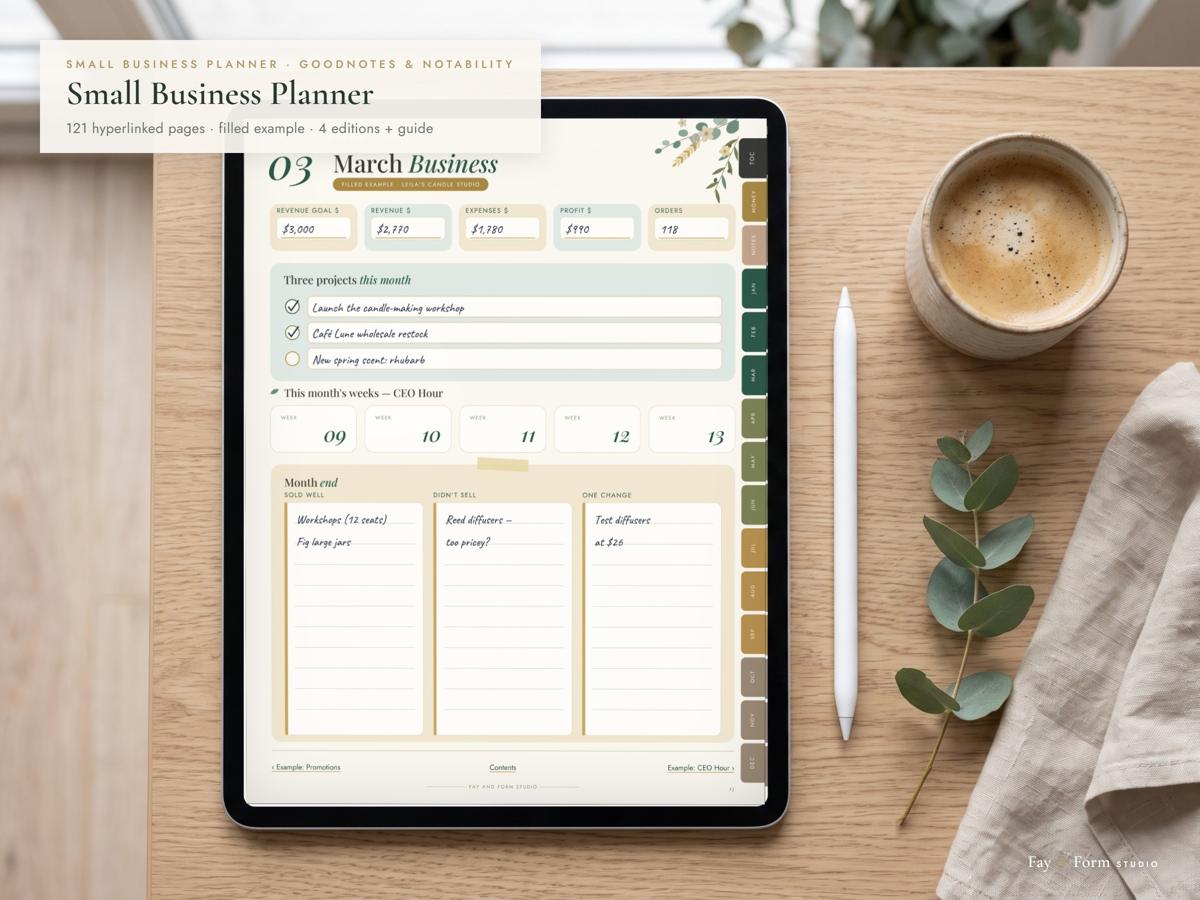
Fay & Form Studio offers two options to suit different preferences. Our Small Business Planner Digital, priced at A$14.90, is a comprehensive 121-page interactive PDF with over 2,300 links. It's built for side hustles, makers, and one-person businesses, helping you know what every sale truly earns, keep orders moving, and dedicate time to growth. It includes a filled example (Leila's candle studio), a pricing calculator, order tracker, CEO Hours, and quarterly/yearly reviews. It comes in US Letter, fillable, and handwriting versions. For those who prefer paper, our Printable Small Business Planner is A$9.90. This 47-page version is designed to print beautifully at home, using less ink, and includes undated templates you can reprint as needed. Both are digital downloads, priced in Australian dollars, meaning nothing is posted.
Ultimately, the best small business planner is the one you use consistently. Whether digital or printable, choose a tool that fits easily into your daily routine and helps you manage and grow your business with confidence.
Frequently Asked Questions
What should a business planner include?
A comprehensive business planner should include sections for strategic planning (goals, business snapshot), financial tracking (income, expenses, pricing calculator), operational management (order tracker, customer lists, stock), and weekly/daily task management (priorities, CEO Hours). It should also account for Australian specifics like the BAS calendar.
Is a paper or digital planner better for a small business?
Both paper and digital planners have benefits. Paper planners offer a tangible, distraction-free experience and are great for visual thinkers. Digital planners provide portability, searchability, and often interactive features like links and fillable fields. The "better" choice depends on your personal preference and how you best organise your thoughts and tasks.
How often should I review my business plan?
While a full, in-depth business plan might be reviewed annually, it's highly beneficial for small businesses to review their goals and progress more frequently. A 90-day plan review is excellent for staying agile, and weekly "CEO Hours" are crucial for adjusting priorities and ensuring you're working towards your larger objectives. Regular reviews help keep your business on track and responsive to change.
Managing a small business in Australia is a process of constant learning and adaptation. A well-chosen and consistently used planner is more than just an organisational tool; it's a strategic partner that helps you clarify your vision, manage your finances, serve your customers well, and navigate your compliance obligations with confidence. By dedicating time each week to planning and review, you're not just getting tasks done; you're actively building and growing the business you envision.
Take control of your business week today. See the Small Business Planner Digital.