Journal · Planning and productivity
Organise Your Studies: The Australian Student Planner
By Fay & Form Studio · 7 October 2026
Managing your studies effectively is key to success, whether you're navigating high school or university in Australia. A student planner isn't just a diary; it's a powerful tool for academic organisation. A student planner earns its keep the week three assignments fall due at once. It helps you keep track of deadlines, plan your study, and stay on top of all your commitments, ensuring you feel prepared rather than overwhelmed.
Why Every Australian Student Needs a Student Planner
Australian academic life has its own rhythm. High school students typically navigate four terms a year, while university students often work through two semesters or sometimes three trimesters. Each period brings new subjects, multiple assignments, and looming exams. Without a clear system, it's easy for tasks to pile up and important deadlines to be missed. A dedicated planner provides that system, offering a central place to record everything and visualise your workload.
From Year 7 to your final university year, the demands on your time grow. Balancing classes, homework, extracurriculars, part-time jobs, and a social life requires smart planning. A well-used planner reduces stress, improves time management skills, and helps you achieve better academic results.
Setting Up Your Planner for the Term or Semester
The first step to making any planner work for you is setting it up properly at the start of each academic period. This initial effort saves you countless hours later on.
Term Overview (High School)
For high school students, begin by mapping out your four terms. Note down key dates like holidays, school events, and major assessment blocks. This bird's-eye view helps you see potential busy periods well in advance.
Semester/Trimester Plan (University)
University students should dedicate a page to their semester or trimester. List all your subjects, noting down lecturer names, contact details, and, most importantly, all assessment due dates. Many universities publish unit outlines at the start, which are goldmines of information. Our Student Planner Digital includes dedicated pages for semester plans, allowing you to tap a subject to open its specific page or notebook.
Class Timetable
Whether you're in high school or university, a clear class timetable is essential. Transfer your weekly schedule into your planner. Include class times, locations, and even the names of your teachers or tutors. This makes it easy to see at a glance where you need to be and when.
Your Assignment Tracker: Working Back from Every Deadline
Assignments are a major part of your grades, and managing them effectively is important. An assignment tracker is more than just a list of due dates; it's a strategic tool. Our planners are designed with this in mind, incorporating a detailed assignment tracker that helps you stay on top of every task.
Instead of just noting the due date, break down each assignment into smaller, manageable steps and assign mini-deadlines. This strategy, often called 'working back from the deadline', turns daunting tasks into achievable goals. The Printable Student Planner also includes these valuable assignment tracking templates.
Here’s a practical way to work back from an assignment deadline:
- Understand the brief (8 weeks out): Read through the assignment instructions carefully. What are the requirements? What's the word count?
- Research and gather resources (6-7 weeks out): Start finding books, articles, and websites. Don't wait until the last minute.
- Outline your structure (5 weeks out): Plan your arguments, main points, and how you’ll organise your response.
- Draft introduction and body paragraphs (3-4 weeks out): Start writing. Don't aim for perfection in the first draft.
- Draft conclusion and references (2 weeks out): Finish the main writing and compile your bibliography.
- First review and edit (10 days out): Read through for content, clarity, and flow.
- Proofread (5 days out): Check for grammar, spelling, and punctuation errors.
- Submit early (1-2 days out): Aim to submit before the absolute deadline. This avoids last-minute tech issues or unexpected problems.
Our planner features help you track each stage: 'started', 'draft', 'final', 'submitted', and even a space for your 'mark'. This detailed approach reduces procrastination and improves the quality of your work.
Organising High School with a Student Planner for High School
High school can feel like a whirlwind of new subjects, friends, and responsibilities. For many, it's the first time they're expected to manage a diverse workload across multiple teachers and subjects. A dedicated student planner for high school is an invaluable tool for navigating these years successfully, helping students build strong organisational habits that will serve them well into university and beyond.
In high school, it's not just about assignments; it's about consistent study, preparing for tests, and managing extracurricular activities like sports or clubs. This helps you allocate time for homework each night, revise for upcoming quizzes, and even schedule in relaxation. This holistic approach ensures you don't just survive high school, but thrive. It's about learning to balance everything, which is a life skill. Our planners provide space for all these elements, making them a comprehensive planner for high school students looking to excel.
Preparing for 2027 and Beyond: Your Student Planner 2027
Looking ahead is a smart move for any student. While academic years come and go, the need for effective planning remains constant. When you're thinking about your studies for the future, perhaps even your student planner 2027, it's wise to choose tools that offer flexibility. An undated planner, like the ones we design at Fay & Form, is perfect for your needs in 2027 and beyond, allowing you to start using it at any point in the year without wasting pages.
The beauty of an undated planner is its adaptability. You can use it year after year, regardless of when you purchase it or if your academic calendar shifts. This makes it a sustainable and cost-effective choice for your student planner 2027 or any year you need it. It’s also ideal for students who might take a break or have an irregular study schedule, as you only fill in the dates as you go. For more insights on planning ahead, you might find our article on 2027 planner Australia useful.
Exam Revision Plan and Weekly Review
Crafting Your Exam Planner
Once exam timetables are released, transfer all dates into your planner. Then, work backwards, just like with assignments. Dedicate specific study sessions for each subject leading up to the exam. Our planners include an Exam Planner with a readiness score, allowing you to gauge your confidence for each subject. We also incorporate Spaced Review, a proven technique where you revisit material at increasing intervals (e.g., 1-3-7-14-30 days) to embed knowledge more deeply. This strategic approach to study sessions is far more effective than last-minute cramming.
The Power of the Weekly Review
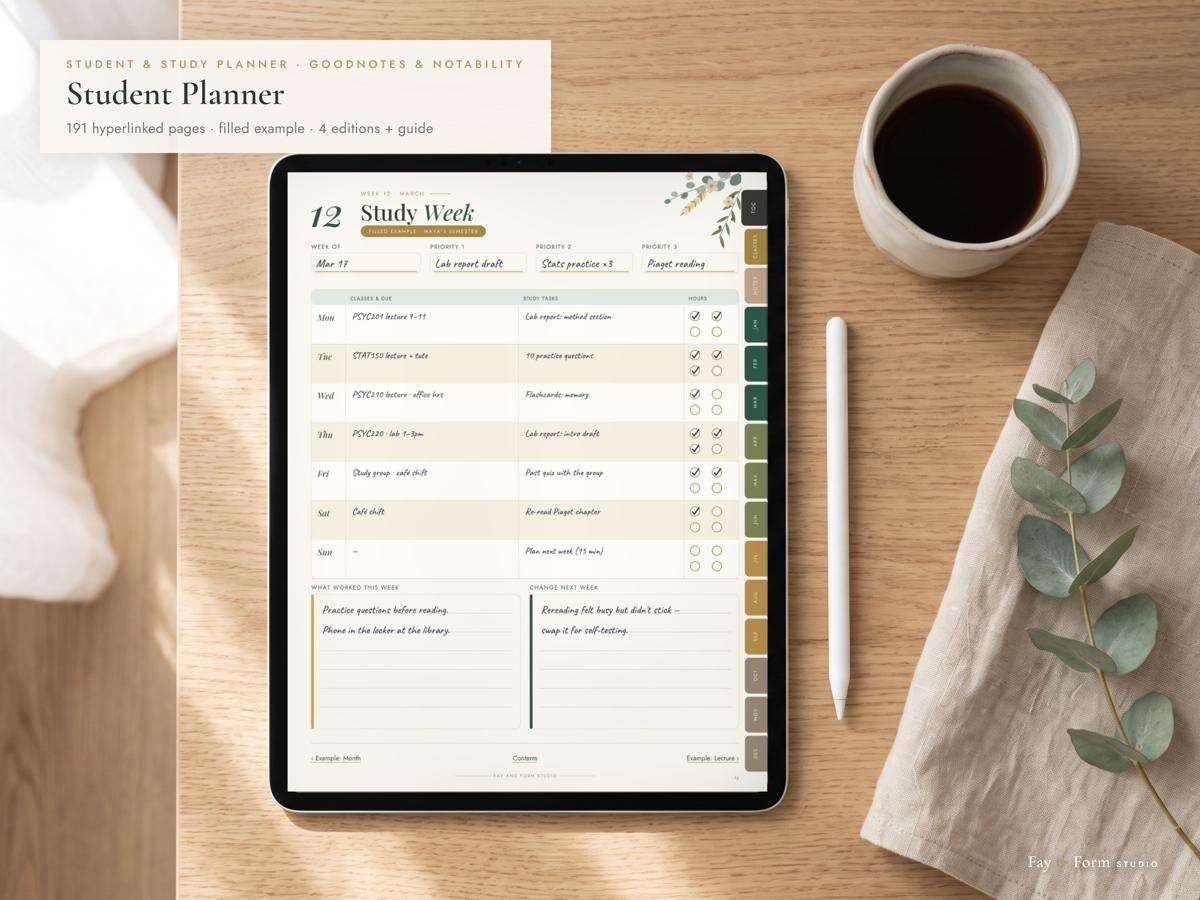
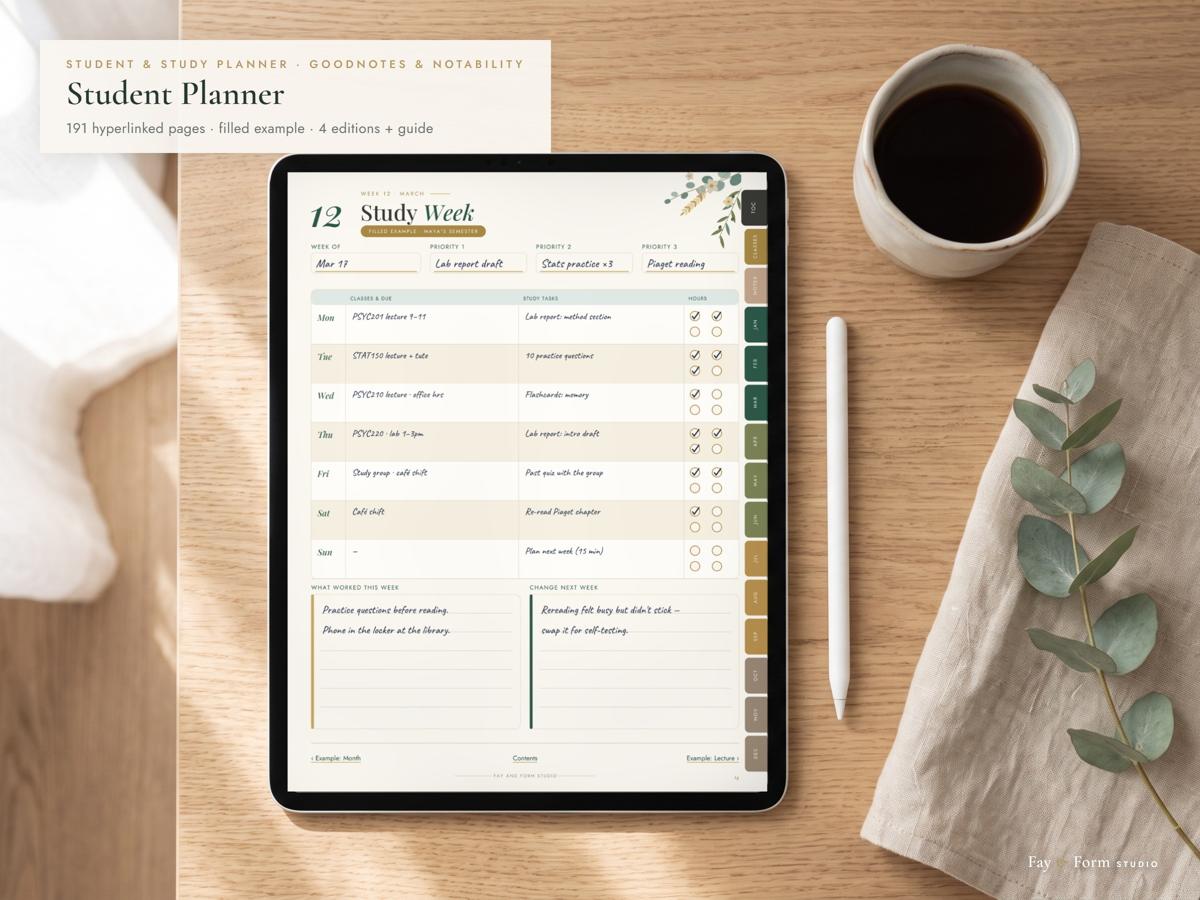
Every week, take a moment to review your progress. This isn't just about ticking off tasks; it's about reflection. Our weekly pages prompt you to identify three priorities for the week, list your classes and deadlines alongside study tasks, and then reflect on 'what worked' at the end of the week. This feedback loop is important for continuous improvement. It helps you understand your study habits, identify areas for improvement, and adjust your plan for the following week. It’s a habit that builds self-awareness and efficiency.
Fay & Form Planners: Designed for Australian Students
At Fay & Form Studio, we design planning tools with real student needs in mind. Our planners are digital downloads, meaning nothing is posted, and you get immediate access to your resources. All prices are in Australian dollars.
Our Student Planner Digital, priced at A$14.90, is a comprehensive 191-page, 3,700+ link interactive PDF. It's designed to help you plan your semester, work back from every deadline, take class notes, and study in a way that actually sticks. It includes a filled example, Semester Plan, Class Timetable, 8 Subject pages, 8 class notebooks (with lecture, Cornell, and grid pages), an Assignment Tracker, Work Back From the Deadline steps, an Exam Planner, Grade Tracker, Reading List, 12 month pages, and 52 study weeks. It comes in two files: a fillable US Letter version for typing or writing, and a handwriting-optimised version without text boxes.
For those who prefer a physical copy, the Printable Student Planner is available for A$9.90. This 50-page paper edition is designed to print beautifully at home, using white pages, light tints, and thin outlines to save ink. Every page is undated, so you can print templates as needed. It includes a 16-page filled example and 32 undated templates.
Beyond our planners, Fay & Form also runs a household planner app. The free plan opens one planner in the app for one person, with no card needed. Sharing with the family starts with Tier 1 at A$29 a year. Ready-made app planners today include the Ramadan kids planner, a home garden planner, and a dog care planner, each with a free demo filled with sample entries.
Frequently Asked Questions
What should a planner include?
A comprehensive planner should include sections for a term or semester overview, a class timetable, a detailed assignment tracker with space for due dates and progress, an exam revision planner, and weekly or daily planning pages that allow for task listing, study session scheduling, and reflection on what worked.
Is a digital planner allowed in class?
Most Australian high schools and universities permit or even encourage the use of digital devices for note-taking and organisation in class. A digital planner, used on a tablet or laptop, can be a convenient way to keep all your academic information in one place and reduce paper use. It's always best to check your specific school or university's policy on device usage during lessons or lectures.
How do I plan around exams and assignments?
Start by transferring all exam dates and assignment due dates into your planner as soon as you have them. For assignments, use a 'work back from the deadline' approach, breaking down the task into smaller steps with mini-deadlines. For exams, create a revision timetable that schedules specific study sessions for each subject, incorporating techniques like spaced review to maximise retention.
A well-utilised planner is more than just a tool; it's an investment in your academic success and personal growth. By taking the time to set it up and use it consistently, you'll gain clarity, reduce stress, and develop invaluable time management skills that extend far beyond your school or university years. Start supporting your studies today.
See the Student Planner Digital