Journal · Wellbeing and growth
How to Use a Fitness Planner to Stay Consistent
By Fay & Form Studio · 7 October 2026
Starting a fitness routine, or getting back into one, can feel overwhelming. There's so much to consider: what exercises to do, how often, and how to measure progress. This is where a dedicated fitness planner helps. A fitness planner turns 'I should train more' into three sessions written into the week. It helps you set clear goals, track your efforts, and celebrate every step forward, making consistency easier. For Australian adults looking to improve their health and wellbeing, a structured approach is key.
At Fay & Form Studio, we design tools to help you live well and grow. We understand the challenges of fitting exercise into a busy life. A well-organised planner provides the structure and motivation you need to stay on track. It helps you focus on progress and consistency, not just the scales.
Why Use a Fitness Planner?
A planner is more than just a diary; it's a strategic partner for your health. It helps you:
- Set Clear Goals: Define what you want to achieve, whether it’s running a 10k, getting stronger, or simply moving more.
- Plan Effectively: Schedule your workouts in advance, ensuring they fit into your week.
- Track Progress: Record your exercises, weights, reps, and cardio sessions. This lets you see how far you’ve come.
- Stay Accountable: Seeing your planned and completed sessions written down can be a powerful motivator.
- Identify Patterns: Notice what works for you and what doesn't, helping you adjust your routine over time.
- Celebrate Successes: Acknowledging your achievements, big or small, keeps your motivation high.
Starting Your Fitness Plan for Beginners
If you're new to exercise or returning after a break, a simple, sustainable fitness plan for beginners is crucial. Don't try to do too much too soon. Start with what you can manage consistently and build from there.
Australian Physical Activity Guidelines
Australia's Physical Activity and Exercise Guidelines for adults recommend:
- 2.5 to 5 hours of moderate activity each week, or
- 1.25 to 2.5 hours of vigorous activity each week.
- Plus, muscle-strengthening activity on at least two days per week.
These guidelines provide a great starting point for shaping your initial fitness plan for beginners. Remember, even short bursts of activity add up.
Setting Realistic Goals
Before you plan, consider what you want to achieve. Make your goals SMART:
- Specific: Instead of "get fit," try "walk 30 minutes, three times a week."
- Measurable: How will you know you've achieved it? (e.g., "lift 5kg more on my squat").
- Achievable: Is it realistic for your current fitness level and lifestyle?
- Relevant: Does it align with your overall health aspirations?
- Time-bound: Set a deadline (e.g., "by the end of the next three months").
If you're unsure where to start, consulting with a healthcare professional or an accredited exercise physiologist can provide personalised advice for your fitness plan for beginners.
Creating Your Weekly Workout Planner
Once you have your goals, it's time to build your weekly workout planner. This involves deciding what types of exercise you'll do and when.
Planning Your Sessions
Think about the types of activity you enjoy and that align with the Australian guidelines. This might include:
- Strength Training: Using weights, resistance bands, or your own body weight. Aim for two days a week.
- Cardio: Walking, jogging, swimming, cycling, or team sports. Spread your moderate or vigorous activity throughout the week.
- Flexibility and Balance: Yoga, Pilates, or stretching.
Look at your week ahead. When do you have dedicated blocks of time? Schedule your workouts like any other important appointment. Be specific: write down the type of workout in your workout planner, the exercises, and the estimated duration.
The "Minimum Week" Approach
Life gets busy, and sometimes your best-laid plans go awry. This is where the concept of a "minimum week" can be very helpful. A "minimum week" means you define the absolute least amount of exercise you'll do, even when life throws curveballs. For example, your ideal week might be three strength sessions and two cardio sessions. Your minimum week might be two 20-minute walks. This approach ensures that a busy week never becomes a failed week. It keeps consistency high and prevents you from feeling discouraged. Fay & Form's Fitness Planner Digital includes a dedicated section for defining your minimum week.
Tracking Progress with Your Fitness Planner and Tracker
A key benefit of a good fitness planner and tracker is its ability to log your workouts. This isn't just about recording what you did; it's about making informed decisions for your next session and seeing your improvements over time.
Logging Workouts: Progressive Overload
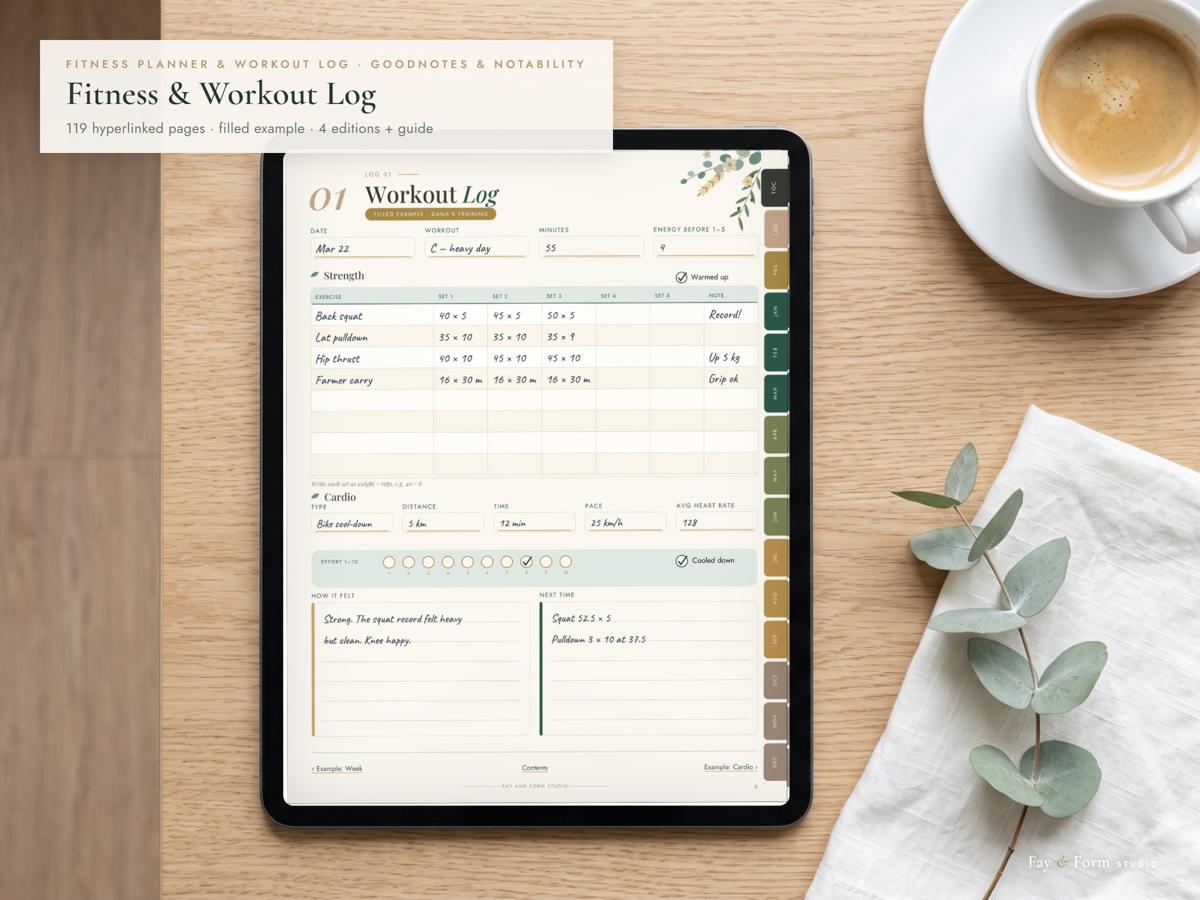
For strength training, the principle of progressive overload is fundamental to getting stronger. This means gradually increasing the demands on your muscles over time. Your fitness planner and tracker should allow you to record:
- Exercise: What you did (e.g., Squats, Push-ups).
- Sets: How many groups of repetitions you performed.
- Reps: How many times you performed the exercise within each set.
- Load/Weight: The weight you lifted or the resistance used.
- Rest: The duration of rest between sets.
- Notes: How the exercise felt, any difficulties, or what you plan to do next time (e.g., "increase weight by 1kg next week," or "try 2 more reps").
By logging this detail, you can clearly see your progress. When you revisit an exercise, you know exactly what you did last time and how to challenge yourself further.
Beyond the Weights: Cardio and Effort
Your planner and tracker isn't just for strength. For cardio, you can log:
- Type: Running, swimming, cycling.
- Duration: How long you exercised.
- Distance: If applicable (e.g., 5km run).
- Pace: Time per kilometre/mile.
- Effort: A rating from 1 to 10 (1 being very easy, 10 being maximum effort). This helps you gauge intensity without fancy equipment.
Recording your effort level provides valuable insight into how your body is adapting. If the same activity feels easier over time, you're getting fitter!
The Fitness Planner Digital helps with progress and consistency. This digital tool offers 30 Workout Log pages, allowing you to track five sets of weight × reps per exercise, plus sections for cardio, effort, and notes on how it felt and what to do next time. There's also a Printable Fitness Planner available for those who prefer pen and paper, priced at A$9.90, designed to print beautifully at home.
Holistic Health Tracking: Sleep, Water, and Steps
Fitness isn't just about workouts; it's about your overall health. A comprehensive planner also encourages you to track other vital aspects of wellbeing.
- Sleep: Aim for 7-9 hours of quality sleep per night. Log your bedtime, wake-up time, and how rested you feel. Good sleep is essential for muscle recovery, energy levels, and mental clarity.
- Water Intake: Staying hydrated is crucial for physical performance and general health. Track how many glasses or litres of water you drink daily.
- Steps: Modern life often means a lot of sitting. Tracking your daily steps encourages you to move more throughout the day, complementing your structured workouts. Aim for a target, such as 8,000-10,000 steps, if that feels right for you.
These elements work together. You'll find that better sleep and hydration can significantly improve your workout performance and recovery.
Measuring Success: More Than Just the Scale
While weight loss is a common goal, focusing solely on the scales can be misleading and demotivating. Muscle weighs more than fat, so your weight might stay the same or even increase as you get stronger, even if your body composition is improving. A good planner helps you track other, more meaningful indicators of progress.
Body Measurements and Photos
Take regular measurements of key body areas, such as your waist, hips, chest, arms, and thighs. Do this once a month at the same time of day for consistency. Side-by-side progress photos, taken in the same lighting and clothing, can also reveal notable changes that the scales won't show. These visual and numerical changes are powerful motivators.
Performance Benchmarks
Your planner should include a section for recording personal bests (PBs) and benchmarks. This might include:
- Your heaviest lift for a specific exercise (e.g., 1-rep max squat).
- Your fastest time for a set distance (e.g., 5km run time).
- How many push-ups or pull-ups you can do.
- How long you can hold a plank.
Retest these benchmarks quarterly to see tangible improvements in your strength, endurance, and overall fitness. The Fay & Form Fitness Planner Digital features a 'Records & Benchmarks' board and quarterly retests to help you celebrate these milestones.
Monthly Check-ins and Quarterly Reviews
Regular review periods are vital for maintaining motivation and adjusting your plan. Use your planner for:
- Monthly Check-ins: At the end of each month, review your consistency grid (how many days you trained), your logged workouts, and your non-scale measurements. Reflect on what went well and what challenges you faced. You might also find it helpful to use gratitude journal prompts during these reviews to focus on positive aspects.
- Quarterly Reviews: Every three months, take a broader look. Revisit your initial goals, retest your benchmarks, and assess your overall progress. This is a great time to set new, challenging goals or refine your current ones.
These structured reviews help you understand your routine, make necessary adjustments, and stay engaged with your fitness goals long-term. The Fay & Form Fitness Planner Digital provides 12 month pages with a 31-day consistency grid and four quarterly check-ins with fill-in rings, making these reviews simple and effective.
Frequently Asked Questions
What should I track in a fitness planner?
A comprehensive planner allows you to track a range of essential data points. This includes your weekly workout plan, specific details for each strength training exercise (sets, reps, weight, and notes for progressive overload), and cardio sessions (type, duration, distance, effort). Beyond workouts, it's beneficial to log daily habits like water intake, sleep duration and quality, and daily steps. Tracking body measurements and performance benchmarks (like personal bests for lifts or run times) provides a holistic view of your progress beyond just weight.
How do I plan workouts for the week?
Planning your workouts for the week involves several steps. First, review your overall fitness goals and the Australian Physical Activity Guidelines. Decide on the types of workouts you'll do (e.g., strength, cardio, flexibility) and how many sessions per week. Look at your schedule and identify specific time slots when you can commit to exercise. Write down the planned workout for each session, including specific exercises, sets, and reps for strength, or duration and type for cardio. Don't forget to define a "minimum week" plan for those busy times, ensuring you maintain consistency even when life gets hectic.
Is a fitness planner better than a fitness app?
Both planners and fitness apps have their advantages, and the best choice often depends on personal preference. A physical or digital planner offers a focused, distraction-free environment for planning and logging, encouraging a more reflective approach. It can feel more tangible to write down goals and progress. While Fay & Form offers a household planner app, our digital planners collection includes options like our A$14.90 Fitness Planner Digital or printable documents (like our A$9.90 Printable Planner), providing a highly interactive PDF experience or a traditional paper-and-pen method. Fitness apps offer convenience and sometimes advanced tracking features, but can also lead to screen fatigue or distractions. Many people find a hybrid approach, using an app for real-time tracking during a workout and a planner for overarching planning and review, works best. For those who enjoy the process of writing and reflecting, a dedicated planner can be incredibly effective.
We hope this guide helps you feel more confident about starting or restarting your fitness routine. Remember, consistency and tracking are important. A well-used planner can help you create change.
Ready to take the next step in planning your fitness routine? See the Fitness Planner Digital.