Ramadan Planner: How to Prepare for Ramadan 2027 in Australia
By Fay & Form Studio · 7 October 2026
Ramadan 2027 falls in the Australian summer, with long days and late iftars, and many Muslim families across Australia are already looking forward to it. Preparing for this blessed month is a journey in itself, and having a well-organised Ramadan planner can make all the difference. A Ramadan planner works best when it is set up in the weeks before the first fast, not on the first night of Ramadan. It turns your intentions into practical steps, helping you and your family embrace the month of fasting, prayer, and reflection with purpose and peace.
At Fay & Form Studio, as designers of dedicated Ramadan and Kids Ramadan planners, we understand the unique needs of Australian Muslim households. This guide is crafted to help you create a comprehensive, genuinely useful, and E-E-A-T-strong approach to your Ramadan preparations, ensuring Ramadan 2027 is your most organised and spiritually fulfilling yet.
Why a Ramadan planner helps
Ramadan is a time of immense spiritual growth, but it also brings changes to our daily routines. From adjusting sleep patterns for Suhoor to managing Iftar preparations, family commitments, work, and school, the month can feel overwhelming without a clear plan. A dedicated Ramadan planner acts as your central hub for all these moving parts. It helps you:
- Set clear intentions: Before the month even begins, a planner prompts you to think about your spiritual, personal, and family goals for Ramadan.
- Stay organised: Keep track of fasts, prayers, Qur'an recitation, good deeds, and meal plans all in one place.
- Maximise your time: By planning ahead, you can minimise last-minute stress and dedicate more precious moments to worship and reflection.
- Involve the whole family: A planner can be a fantastic tool to engage children and foster a sense of shared purpose and excitement for Ramadan.
- Reflect and grow: Weekly and end-of-Ramadan reflections help you assess your progress and identify areas for continued growth.
Ultimately, a well-used Ramadan planner is an investment in a more peaceful, productive, and spiritually enriching Ramadan experience for everyone in your household.
When does Ramadan 2027 start in Australia?
For Muslim families in Australia, anticipating the start of Ramadan is always an exciting time. The exact date often depends on the moon sighting traditions followed by your local mosque or council. However, based on astronomical calculations, Ramadan 2027 (1448 AH) is expected to begin around Monday 8 February 2027 in Australia. It’s important to confirm with your local Islamic authority closer to the time.
Ramadan lasts either 29 or 30 days, depending on the sighting of the new moon. Following the conclusion of Ramadan 2027, Eid al-Fitr, the festival of breaking the fast, is expected to fall around 9 or 10 March 2027. Knowing these dates in advance allows you ample time to prepare your home, family, and spiritual goals for the blessed month ahead.
A Ramadan planner checklist for the four weeks before
The weeks leading up to Ramadan are crucial for preparation. Using a dedicated Ramadan planner checklist can help you systematically cover all the essential tasks, ensuring you enter the month feeling calm and ready. Here’s what a comprehensive Ramadan planner checklist should include:
- Make-up Fasts (Qada) from Last Year: If you missed any fasts from the previous Ramadan due to travel, illness, or other valid reasons, now is the time to make them up. Tick them off as you complete them.
- Zakat al-Fitr Amount: Research the recommended Zakat al-Fitr amount for your local area. This is usually announced by major Islamic organisations closer to Ramadan. The amount per person is set each year, so check the current figure with your local mosque, a reputable zakat organisation or a scholar.
- Sadaqah Plan: Plan your charitable giving for the month. Decide which charities you'd like to support and how frequently. Consider setting up recurring donations for ease.
- Meal Planning: This is a big one! Plan your Suhoor and Iftar meals for at least the first week, if not more. This saves time and reduces waste.
- Grocery List: Based on your meal plan, create a master grocery list. Consider doing a bulk shop before Ramadan starts to stock up on staples.
- Work and School Timetable Adjustments: Discuss flexible hours with your employer if possible. For children, understand school schedules and communicate any fasting plans with their teachers.
- Home Organisation: Declutter and clean your home, especially prayer areas. Create a peaceful environment conducive to worship.
- Qur'an Goals: Set a realistic goal for Qur'an recitation. Will you aim for one juz a day?
- Du'a List: Start compiling a list of personal supplications you want to make throughout the month.
A thorough Ramadan planner checklist ensures no important detail is overlooked, allowing you to focus on the spiritual aspects of the month.
Turning intentions into a Ramadan action plan
Ramadan is a time for renewing intentions and striving for spiritual excellence. Simply wishing for a productive month isn't enough; you need to turn those hopes into a concrete Ramadan action plan. Your planner should have a dedicated intentions page where you articulate your goals across different areas:
- Spiritual Goals: What do you want to achieve in your prayers, Qur'an recitation, dhikr, and du'a? For instance, 'Pray all five prayers on time every day,' 'Read 20 pages of Qur'an daily,' or 'Memorise 5 new surahs.'
- Personal Growth Goals: Are there habits you want to break or cultivate? 'Reduce screen time,' 'Practice patience with children,' or 'Forgive someone.'
- Family Goals: How can you make Ramadan a shared experience? 'Have Iftar together every night,' 'Read a Qur'an story to the kids,' or 'Engage in family dhikr sessions.'
- Community Goals: How will you serve others? 'Volunteer at the mosque,' 'Prepare Iftar for neighbours,' or 'Support a local charity.'
Once your intentions are clear, the next step in your Ramadan action plan is to break them down into smaller, manageable steps. For example, if your intention is to read the entire Qur'an, your action plan would include 'read 4 pages after each of the five prayers.' This structured approach helps you stay accountable and motivated throughout the month.
What a Ramadan daily planner page should hold
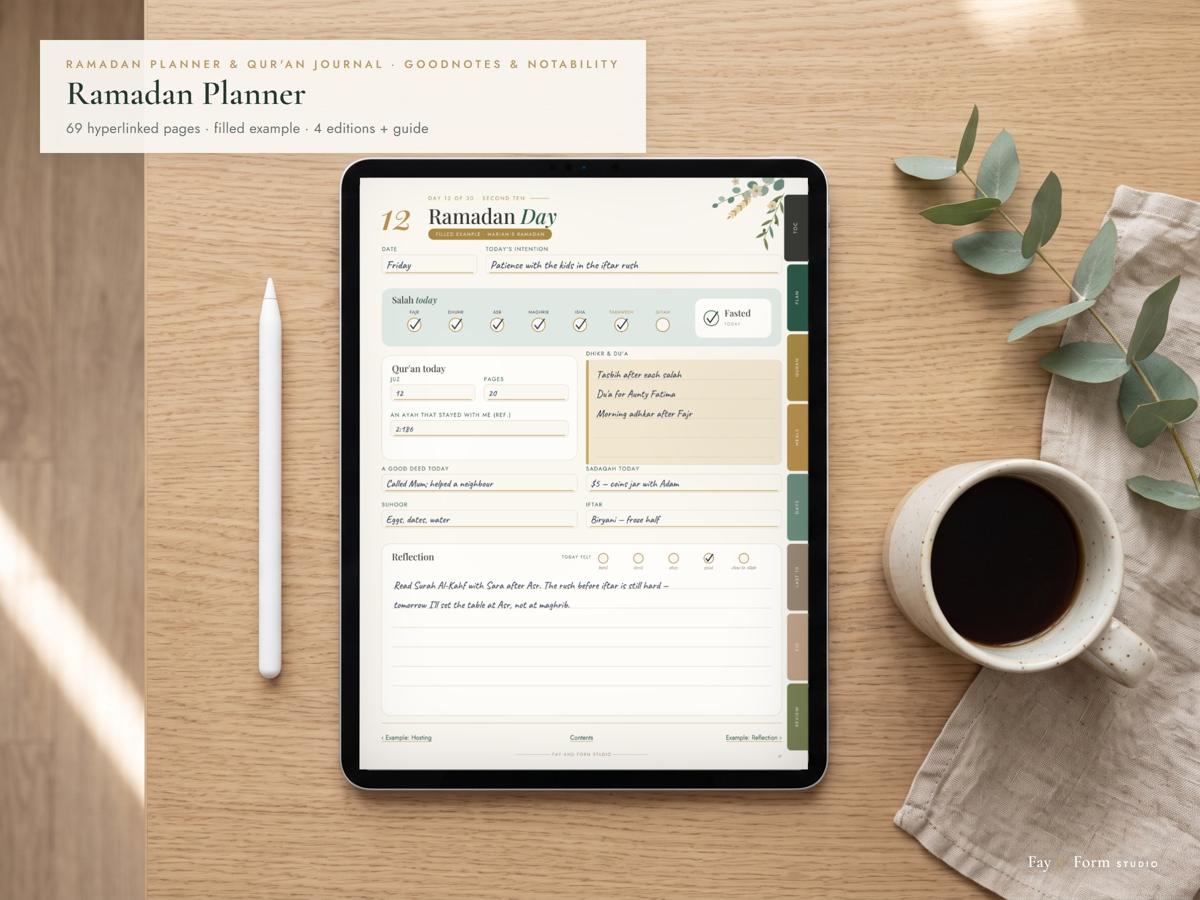
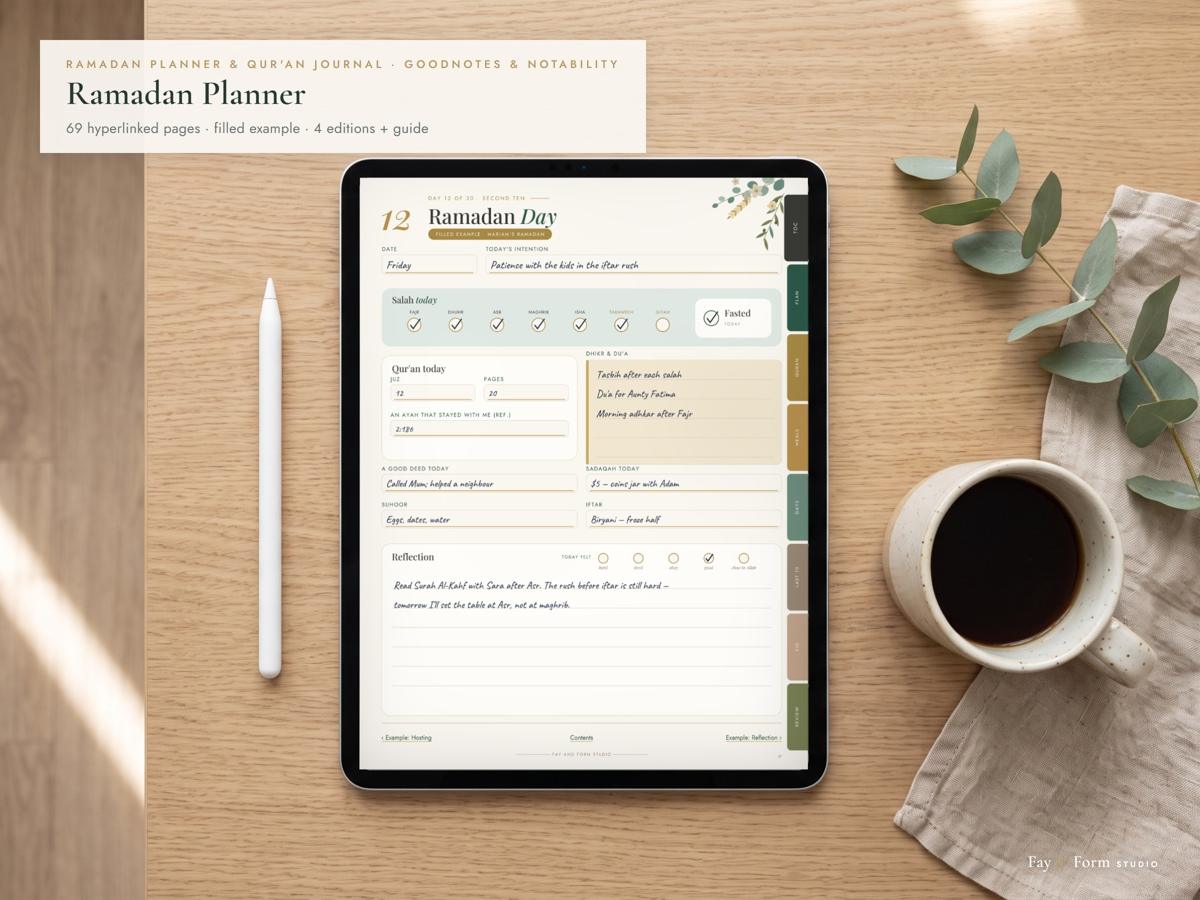
The heart of any effective Ramadan planner is its daily page. This is where you track your progress, reflect on your day, and keep your intentions at the forefront. A well-designed Ramadan daily planner page, like those in our Fay & Form planners, should include:
- Date & Day of Ramadan: Essential for tracking progress through the month.
- Fasted (Yes/No/Partially): A simple tick box to mark whether you fasted the full day, part of the day (especially for children or those with valid exemptions), or not at all. Remember, for children, every try counts!
- The Five Prayers + Taraweeh: Checkboxes for Fajr, Dhuhr, Asr, Maghrib, Isha, and Taraweeh prayers. This helps ensure you're performing all your daily obligations.
- Qur'an Pages Read: A section to note down how many pages or ayats you've read, keeping you on track with your recitation goals.
- Dhikr Count/Type: A space to record your daily remembrance of Allah, whether it's specific adhkar (e.g., Subhanallah, Alhamdulillah, Allahu Akbar) or general istighfar.
- A Good Deed: A prompt to record one good deed you performed that day. This encourages conscious acts of kindness and generosity.
- Sadaqah: A small box to note if you gave any charity that day, reinforcing the habit of giving.
- Meals (Suhoor & Iftar): A simple log of what you ate, which can be useful for managing energy levels and nutrition.
- One-Line Reflection: A small space to jot down a thought, feeling, or lesson learned from the day. This is invaluable for spiritual growth.
For more detailed guidance on structuring your daily worship and reflections, you might find our article on Ramadan Daily Planner helpful. A consistent Ramadan daily planner ensures that every day is lived with purpose and gratitude.
Planning the Qur'an: pages per day
One of the most cherished goals for many during Ramadan is to complete a full recitation of the Qur'an (khatm al-Qur'an). This spiritual journey is made much easier with a clear plan. A standard 604-page mushaf (copy of the Qur'an) can be completed in 30 days by reading approximately 20 pages a day. This might sound like a lot, but it becomes very manageable when broken down: that's just 4 pages after each of the five daily prayers.
Your Ramadan planner should include a 30-juz Qur'an grid or tracker. This allows you to visually mark off each juz (section) or even specific page counts as you complete them. Seeing your progress can be incredibly motivating. Consider these tips for consistent Qur'an recitation:
- Set a dedicated time: Immediately after prayer is ideal, as it fits easily into your existing routine.
- Read with understanding: Even if you're aiming for completion, take a moment to reflect on the meaning of what you're reading.
- Don't get discouraged: If you miss a day, simply pick up where you left off. The goal is consistency and connection, not perfection.
- Utilise audio: Listen to Qur'an recitation while commuting or doing chores to keep your heart connected.
By integrating a clear Qur'an plan into your planner, you'll find it much easier to achieve this beautiful spiritual goal during Ramadan.
Suhoor, iftar and the grocery list
Meal planning during Ramadan is more than just about food; it's about nourishing your body and soul for worship, saving time, and reducing food waste. Your Ramadan planner should dedicate sections to Suhoor and Iftar meal plans, along with a running grocery list.
Weekly Meal Plans: Suhoor & Iftar
Planning meals weekly can significantly reduce stress. Consider creating two separate weekly grids:
- Suhoor Meal Plan: Focus on foods that provide sustained energy and hydration. Think oats, eggs, wholemeal toast, fruits, and plenty of water.
- Iftar Meal Plan: Plan a balanced meal with dates, water, soup, a main dish, and a side. Don't forget healthy snacks for later in the evening.
By planning, you can ensure variety and make the most of ingredients.
The Essential Grocery List
As you plan your meals, create a comprehensive grocery list. Categorise items (e.g., dairy, produce, pantry staples, meat) to make shopping efficient. Doing a large grocery run before Ramadan and then smaller top-up shops weekly can save immense time during the fasting days.
Iftar Hosting Plan
Many families enjoy hosting Iftars during Ramadan. Your planner can help you manage this with ease:
- Guest List: Who will you invite and on which dates?
- Menu: Plan specific dishes for your guests.
- Delegation: If comfortable, assign dishes to family members or ask guests to bring something.
- Shopping List: Create a separate list for your hosting needs.
By planning your meals and groceries, you're not just feeding your family; you're creating a smoother, more enjoyable Ramadan experience.
The last ten nights and Eid al-Fitr
The last ten nights of Ramadan are considered the most blessed, containing Laylat al-Qadr (the Night of Decree). Your Ramadan planner should have a special section dedicated to these crucial nights to help you maximise your worship. The last ten nights include the odd nights (21st, 23rd, 25th, 27th, 29th) when many seek Laylat al-Qadr.
Last Ten Nights Page
This page can include:
- Specific Du'as: A list of supplications particular to these nights.
- Increased Worship Goals: Plan for extra Qur'an recitation, Qiyam al-Layl (night prayers), and dhikr.
- Sadaqah Targets: Many increase their charity during these nights.
- Personal Reflection Prompts: What spiritual breakthroughs are you seeking?
Eid al-Fitr Planner
After the spiritual intensity of Ramadan, Eid al-Fitr is a joyous celebration. Planning for Eid within your Ramadan planner ensures a smooth transition:
- Eid Outfit Planning: Decide on clothing for yourself and the family.
- Gifts: Plan gifts for children, family, and friends.
- Eid Meal Prep: Decide on your Eid feast menu.
- Decorations: Plan any home decorations.
- Visits: Schedule visits to family and friends.
For more festive ideas and printables for the celebration, explore our Eid and Ramadan Printables.
Six Days of Shawwal
The blessings don't end with Ramadan. Fasting six days in Shawwal (the month after Ramadan) is highly recommended. Your planner should include a tracker for these optional fasts, helping you extend the spiritual momentum of Ramadan into the new Islamic year.
Ramadan Review
Finally, a dedicated Ramadan review section encourages reflection on your journey. What went well? What could be improved next year? This self-assessment is key for continuous spiritual growth.
A Ramadan planner for kids that keeps it gentle
Involving children in Ramadan is a beautiful way to instil love for their faith. A dedicated Ramadan planner for kids should be engaging, encouraging, and most importantly, gentle. The goal is to make them feel part of the spiritual journey, not burdened by it. Remember that children are not required to fast, and every try counts, whether it's a few hours or a half day.
Our Kids Ramadan Planner (digital A$12.90, printable A$10.90) is designed with this in mind, offering 49 pages of engaging activities:
- Moon Tracker: Kids can colour in a moon each day of Ramadan.
- Good Deeds Tracker: A fun way to record acts of kindness and worship.
- Fasting Tracker: Simple options like 'none,' 'part of the day,' or 'all day' to celebrate their effort without pressure.
- Qur'an Chart: To track their progress in reading or memorising.
- Kindness Bingo: Encourages various acts of kindness.
- 30 Daily Pages: Simplified versions of the adult daily planner.
- Eid Page: To plan and look forward to the celebration.
This approach allows children aged 4 to 11 to participate at their own pace, fostering a positive association with Ramadan. For more ideas on engaging your little ones, check out our insights on Ramadan Planner for Kids.
Paper, GoodNotes or a Ramadan planner app?
With so many options available, choosing the right format for your Ramadan planner depends on your personal preference and family needs. Each option offers distinct advantages:
Paper Planners
Pros: A paper page is fastest to start. There's a tactile satisfaction in writing things down and ticking boxes. No screens, no distractions, just you and your plan. Our Printable Ramadan Planner (A$9.90) allows you to print in colour or black and white, offering a traditional, hands-on experience.
Cons: Not easily editable once written. Can be bulky to carry around. Not shareable in real-time with family members.
Digital Planners (e.g., GoodNotes, Notability)
Pros: The best of both worlds. You get the writing experience with a stylus on a tablet, plus the flexibility of digital. You can easily duplicate pages, erase, move sections, and keep everything neat. Our Ramadan Planner 2027 Digital (A$14.90) is designed for GoodNotes and Notability, is 69 pages, undated for reuse, and comes with phone and A4 versions, offering flexibility wherever you are.
Cons: Requires a tablet and stylus. Can still be a single-user experience unless you manually share pages.
Ramadan Planner App
Pros: An app is easiest to keep when more than one person needs the same plan. Our free Ramadan planner app for kids is a fantastic example. Children can tick off fasts and five prayers, Qur'an pages, a good deed, and a du'a each day. Weekly totals add up automatically, and parents see the same planner on their phone, fostering shared family goals. The free plan covers one planner for one person, and family sharing starts at A$29 a year.
Cons: Relies on screen time. Can have a learning curve for new users. Subscription costs for family features.
For a deeper dive into the benefits and features of digital tools, explore our article on Ramadan Planner App options. Whether you prefer the simplicity of paper, the flexibility of digital, or the shared experience of an app, there's a Ramadan planner solution that fits your family's needs for a blessed Ramadan 2027.
Frequently Asked Questions
Is Ramadan 29 or 30 days?
Ramadan lasts either 29 or 30 days, depending on the sighting of the new moon. The Islamic calendar is lunar, so the length of the month can vary each year.
What date is Ramadan in Australia in 2027?
Ramadan 2027 (1448 AH) is expected to begin around Monday 8 February 2027 in Australia, though this depends on the moon sighting followed by your local mosque or council.
Is there a free Ramadan planner printable?
While many simple free printables might be available online, for a comprehensive, high-quality option, Fay & Form Studio offers a Printable Ramadan Planner for A$9.90, which can be printed in colour or black and white. Our kids' app also has a free plan for one user.
Can I use a Ramadan planner in GoodNotes?
Yes, absolutely! Our Ramadan Planner 2027 Digital is specifically designed for use with apps like GoodNotes and Notability on tablets, offering an interactive digital planning experience.
Should I plan the last ten nights separately?
Yes, it's highly recommended to plan the last ten nights separately. These nights hold immense spiritual significance, including the possibility of Laylat al-Qadr. Dedicated planning helps maximise your worship during this blessed period.
Preparing for Ramadan 2027 is a journey that begins long before the first fast. By investing time in creating a thoughtful Ramadan planner, you're not just organising tasks; you're setting the stage for a month of profound spiritual growth, family connection, and immense blessings. Whether you choose a paper planner, a digital version for GoodNotes, or a collaborative app, the goal remains the same: to approach Ramadan with intention and purpose. Take the first step towards your most organised Ramadan yet.
Try the Ramadan planner app free.